About the project
This document is a working document for the project. It provides supporting information for project participants, reviewers and viewers. It is not part of the project deliverables.
Introduction to the Project
The UN/CEFACT Global Trust Registry Project (“GTR project”) is capturing and specifying the requirements, governance and technical foundation for a digital directory, publicly accessible and hosted by the United Nations, that would list authoritative registrars of participating UN Member States and the registers that they maintain. The purpose of the UN Global Registrar Information Directory (GRID) is to facilitate digital trust, verification, and interoperability in the global supply chain and public administration systems.
The GRID will enable organisations to verify whether a trade relevant credential (e.g., a commercial registration number, a property title, a trademark ownership certificate) has been issued by a valid and recognized authoritative registrar. It will also mitigate risks of impersonation, forgery, or unverifiable claims that may arise from fragmented or opaque national systems.
To facilitate verification, the GRID will also record if Registrars issue digital credentials or otherwise enable online verification of their register contents and who they have been issued to. In support of the use of verifiable digital credentials, the project will review how Registrars can use the UNTP "Digital Identity Anchor" (DIA) specification 1 to issue verifiable identifiers for supply chain relevant claims and how these can further support global supply chain transparency and verification. The DIA review will generate guidelines on the use of the DIA specification, and may also generate proposed changes to the DIA specification for the UNTP team.
In summary: the GRID will provide a trustworthy map to the world's supply chain registrars and a guide to how and what they register; and DIAs provide verifiable proof of the registrations of registrars.
The diagram below is a logical model of the GRID showing a transaction flow across supply chain participants and interactions with the GRID by participants and registrars.
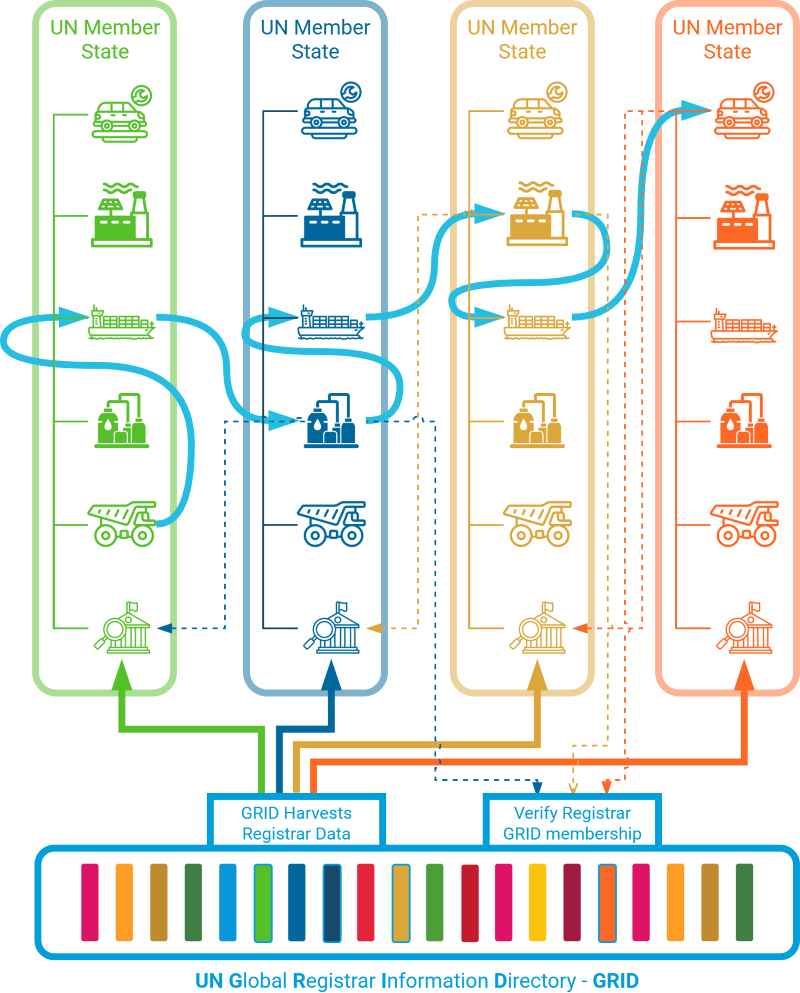
Context model of the Global Registrar Information Directory
The GRID Objective
Achieving the GRID will demand defining a framework for identifying, listing, and verifying authoritative public legal registers that issue or certify identifiers related to rights, ownership, legal personality, or public status under national or international law. With a focus on supply chains and trade, these may include: commercial and corporate registers, land and real estate property registers, registries of movable assets and secured transactions, intellectual property and trademark registries, etc.
The framework needs to confirm institutional legitimacy, legal reliability, and operational integrity of listed registrars and the registers they maintain. This needs to be aligned with internationally recognized principles of registration and legal publicity. Identifying minimum requirements for legal authority, governance, and verifiability will promote legal certainty and cross-border digital trust.
Further, and in order for the GRID to remain relevant and useful, it needs to be designed and built well and be operationally sustainable. The project will propose an example operating model that shows how the GRID could be self-sustaining. This will be based on a participatory model (such as that adopted by ICAO's PKD). Two key principles of the GRID model are that Registrars should be empowered (and incentivised) to maintain their own data in the GRID, and that the GRID itself should be run as efficiently as possible.
There are a number of architectural options available for the GRID to provide its services, in broad terms these range from centralised architectures (where the GRID is the focal point for proof of recognition of a Registrar) to decentralised architectures (where the GRID issues recognition to Registrars). These offer different benefit profiles.
DIA Recommendations
The second project objective is to provide recommendations on the data schema, and issuance and validation processes of the UNTP Digital Identity Anchor (DIA) 2. The DIA is one of the verifiable credentials defined in the UNTP protocol specification. The GTR project is reviewing the proposed data schema and use of the DIA by authoritative sources (Registrars). The DIA is not a new identifier, it enables Registrars to make use of the identifier(s) they already issue in a verifiable credential that they can issue to the register applicant together with the applicant's supplied decentralised identifiers (DID(s)) 3.
The aim of using the DIA together with GRID registration is to foster interoperability, transparency and trust across different UN Member States authoritative Registrars who can use their existing processes and identifier definitions within verifiable credentials. This will give increased confidence in digital public services and international business across supply chains.
GRID and DIA Role in Trade Flows
The sequence diagram below shows three distinct interactions:
- A registrar applying to be a member of the GRID
- A supply chain participant (supplier in the example below) registering with a Registrar and applying for a DIA
- A suppler shipping goods and documentation to a buyer who verifies the goods and documentation before receipt and payment approval
Sustainable Development Goals
The GTR project supports implementation of the UN Global Digital Compact and the 2030 Agenda for Sustainable Development, particularly through the promotion of digital trust infrastructure, legal identity for all (SDG 16.9), resilient legal frameworks (SDG 9.1), and transparent governance (SDG 16.5 and SDG 12.6).
Project Management and Delivery
Ways of working
The GTR project broadly follows the UN/CEFACT Open Development Process (ODP) 2. This means that there are public review stages for deliverable documents and artefacts and associated "exit" criteria. "Exit criteria" in ODP are equivalent to acceptance criteria - the way(s) in work is checked to be complete and of required quality. "Project Exit" - stage 5 of the ODP lifecycle means that all deliverables have met their acceptance criteria.
The following text is taken from the UN/CEFACT Open Development Process 2
All projects concerned with the development of UN/CEFACT deliverables within the UN/CEFACT Programme of Work need to follow a set of ODP stages related to their deliverable’s publication type. All ODP stages are briefly listed below:
ODP Stage 1: Project Inception
ODP Stage 2: Requirements Gathering
ODP Stage 3: Draft Development
ODP Stage 4: Public Review
ODP Stage 5: Project Exit
ODP Stage 6: Publication ODP Stage 7: MaintenanceThe minimum set of ODP stages for all projects are:
- (ODP Stage 1) Project Inception
- (ODP Stage 5) Project Exit
- (ODP Stage 6) Publication
The list (s) of ODP stages for projects with more than one deliverable is the list of stages required by the deliverable that, if it were the only deliverable for the project, would trigger the most stages. Deliverables that would not trigger specific stages are exempt from them.
The actual list of ODP stages required by a project’s individual deliverables, if different from those for the overall project, are described in the Project Inception stage.
Across the range of deliverables for the project (see below), this project expects to make use of all stages of the ODP.
The project is active and all deliverables are currently in stage 3. This means that all documents are draft and subject to change. None should be considered definitive unless marked as such.
Deliverables
A table of deliverables from the original project brief together with the original exit criteria is shown below.
| # | Deliverables from Project Brief | Original Exit Criteria |
|---|---|---|
| PD1 | Digital Identity Anchor Requirements (BRS) | Completes public review |
| PD2 | Global Trust Register Requirements (BRS) | Completes public review |
| PD3 | Trust Register Governance Framework (Recommendation) | UN/CEFACT Bureau approval |
| PD4 | DIA credential Schema & vocab | Two verifiable implementations |
| PD5 | Trust Register Pilot system | Two registered identity schemes |
| PD6 | Implementation Guidance (Guidance) | Two verifiable implementations |
The original brief 4 was written in January 2025 and a call for participation published in April 2025. Work since then has identified a set of documents that map to these deliverables and support the overall project purpose of "uplifting trust and integrity as well as equitable inclusion within the global digital and sustainable trade ecosystem" (see purpose statement in brief).
The table below maps project deliverables from the brief to project documentation and artefacts in this repository. In addition it describes the purpose, acceptance criteria, and target audience (for the accepted artefact). In some instances, more than one project document is used to satisfy a deliverable.
| Brief Ref # | Title | Focus | Exit (acceptance) Criteria | Primary Audience |
|---|---|---|---|---|
| New | Economic Argument | The global economic argument for the GRID and use of the DIA. This includes consideration of an operational GRID funded and operating in a similar fashion to the established ICAO PKD model. | Document Public Review & Bureau Approval | Gov Reps & Economists |
| New | Glossary | Definition of terms and acronyms used in the project documentation. | Document Public Review & Bureau Approval | All |
| PD1 | DIA Legal & Data Structure | The DIA "Trust Wrapper" concept (not a new identifier), use patterns, and the legal articles defining functional equivalence and liability. | Document Public Review & Bureau Approval - supported by Pilots | Regulators & Lawyers |
| PD2 | GRID Legal Governance & TOM | The operating and legal framework for the GRID Board, membership eligibility, and formal legal annexes (Indemnity, Immunity, and Dispute Resolution). | Document Public Review & Bureau Approval | Secretariat, Lawyers & Gov Reps |
| PD2 | Participating Registrar Data Schema | Standardized metadata for GRID listing and how the GRID design supports the "inclusive maturity model" for participation. | Document Public Review & Bureau Approval - supported by Pilots | Registrar IT & Data Leads |
| PD3 | GRID Legal Governance & TOM | The operating and legal framework for the GRID Board, membership eligibility, and formal legal annexes (Indemnity, Immunity, and Dispute Resolution). | Document Public Review & Bureau Approval | Secretariat, Lawyers & Gov Reps |
| PD4 | DIA Legal & Data Structure | The DIA "Trust Wrapper" concept (not a new identifier), use patterns, and the legal articles defining functional equivalence and liability. | Document Public Review & Bureau Approval - supported by Pilots | Regulators & Lawyers |
| PD5 | Pilots and Pilot Documentation | Proof of Concepts for the GRID and DIA, including decentralized harvesting, key management, and DIA issuance. | Document Public Review & Bureau Approval - supported by Pilots | Technical Leads & Pilots |
| PD6 | Implementation Guidelines | Description of how the GRID can be established by UN/CEFACT (or another UN body), how Registrars can join the grid and how the DIA concept can be used by those that choose to use it. | Document Public Review & Bureau Approval - supported by Pilots | All |
| New | Annex A - Technical Reference GRID & DIA | Supporting implementation details that do not belong in the high-level economic argument | Document Public Review & Bureau Approval - supported by Pilots | Ministers & Economists, Technical Leads |
| New | Annex B - ROI Model | Illustrative framework for thinking about fiscal impact and return on investment (ROI) for a UN Member State participating in GRID/DIA | Document Public Review & Bureau Approval | Gov Reps & Economists |
| New | Annex C - Economic Argument Research Paper | Detailed research on the economic argument for GRID and the use of the DIA | Document Public Review & Bureau Approval | Economists |
Schedule
Project Brief Deliverables
The project call to participation was released in April 2025 and work commenced shortly after. To enable easier viewing, the schedule below focuses on the 2026 timeframe.
Two schedules are presented: the first represents the delivery of the set of project documents for review by the UN/CEFACT bureau. Subject to approval, these are expected to be released in the first half of 2026. This schedule, from January to July 2026, is shown below.
Optional and to be agreed - Recommendation
Depending on the response to the first set of documents, and agreement with the UN/CEFACT Bureau and GTR Project Team, the project may produce a UN/CEFACT Recommendation. An example schedule for this showing how this work could meet the November plenary is shown below.
Notes:
- This schedule starts from May 2026.
- Achieving this shedule requires that a decision to produce a recommendation is made after the project brief deliverables are published for review but before the end of the review period.
Explainers
The project maintains a Google Slides presentation that is updated as required and retains previous versions (through the Google Slide file version history). The Google slide project explainer can be found here:
Google Slides Explainer
We produce a PDF of this explainer from time to time:
View Project Explainer PDF (Mar 2026)
We also have an explainer of the logical model for the GRID, this is available as a PDF:
View GRID Explainer PDF (Nov 2025)