Architecture Overview
Goals
Global trade still runs largely on paper and PDF. Despite 50 years of digitalization effort, only around 10% of cross-border trade is digital. Traditional approaches based on connecting IT systems through networks of hubs and pipes have proven costly, complex, and unable to reach all the parties that need a given trade document.
UNVTD takes a different approach: trade documents are issued as portable, verifiable credentials that travel with the consignment — no shared infrastructure required. The goals are:
- Zero infrastructure cost — no hubs or intermediary platforms needed.
- No counter-party dependency — each party implements independently, at their own pace.
- Universal accessibility — the same document works whether processed digitally or read as a rendered document.
- Fraud resistance — cryptographic signatures provide integrity assurance that cannot be faked.
- Decentralized by design — no central store to attack, no platform lock-in.
Principles
Decentralization. No central authority, platform, or registry is required to issue, exchange, or verify a trade document.
Verifiability. Every document can carry cryptographic proof of who issued it and that it has not been tampered with, using the W3C Verifiable Credentials standard.
Strong Semantics. Every property is mapped to a precise URI via JSON-LD context anchored to authoritative vocabularies including the UN/CEFACT Web Vocabulary , eliminating ambiguity across jurisdictions and languages.
Trusted Identity. Issuers are identified by Decentralized Identifiers (DIDs) linked to authoritative registrations — the institutional trust anchors that society already relies on, now made digitally verifiable.
Opinionated but Adaptable. Deliberate technology choices minimize ambiguity, while each layer (data model, semantic context, cryptographic envelope) remains independently useful for selective adoption.
Key Architecture Concepts
The architecture is built on three pillars, each explored in detail on its own page:
Portable Credentials
Why traditional hub-and-pipe models have failed to scale, and how the portable credential model — inspired by the e-passport — enables document exchange without shared infrastructure.
Business Wallets
How businesses store, manage, and present their verifiable trade documents using digital wallets — the software equivalent of a document folder that travels with the business.
Transferable Records
How documents that confer rights or title (such as bills of lading) can be represented as transferable digital records with singularity guarantees.
Semantic Model
The ICC-DSI Key Trade Documents and Data Elements (KTDDE) identifies 36 essential trade documents spanning commercial, transport, financial, and regulatory categories. These form the requirements baseline for UNVTD’s semantic scope.
For each trade document, the project delivers three complementary artifacts:
- JSON Schema — defines the document’s structure, validation rules, and data types. Schemas are kept inline (no
$refreferences) for clarity and self-containment. - JSON-LD @context — maps every property to a precise URI in authoritative vocabularies, primarily the UN/CEFACT Web Vocabulary, enabling machines to establish semantic meaning without human intervention.
- JSON Example — a concrete, valid instance that tells a cohesive business story and validates against the schema.
The semantic model is extensible without breaking interoperability. Issuers may include additional properties beyond the schema; receiving systems process the standard fields and safely ignore extensions. The JSON-LD @context enhances interoperability but is not required — systems can treat any document as standard JSON.
Trust Model
Cryptographic signatures prove a document was issued by a specific DID and has not been tampered with. But cryptography alone does not answer: should I trust this issuer?
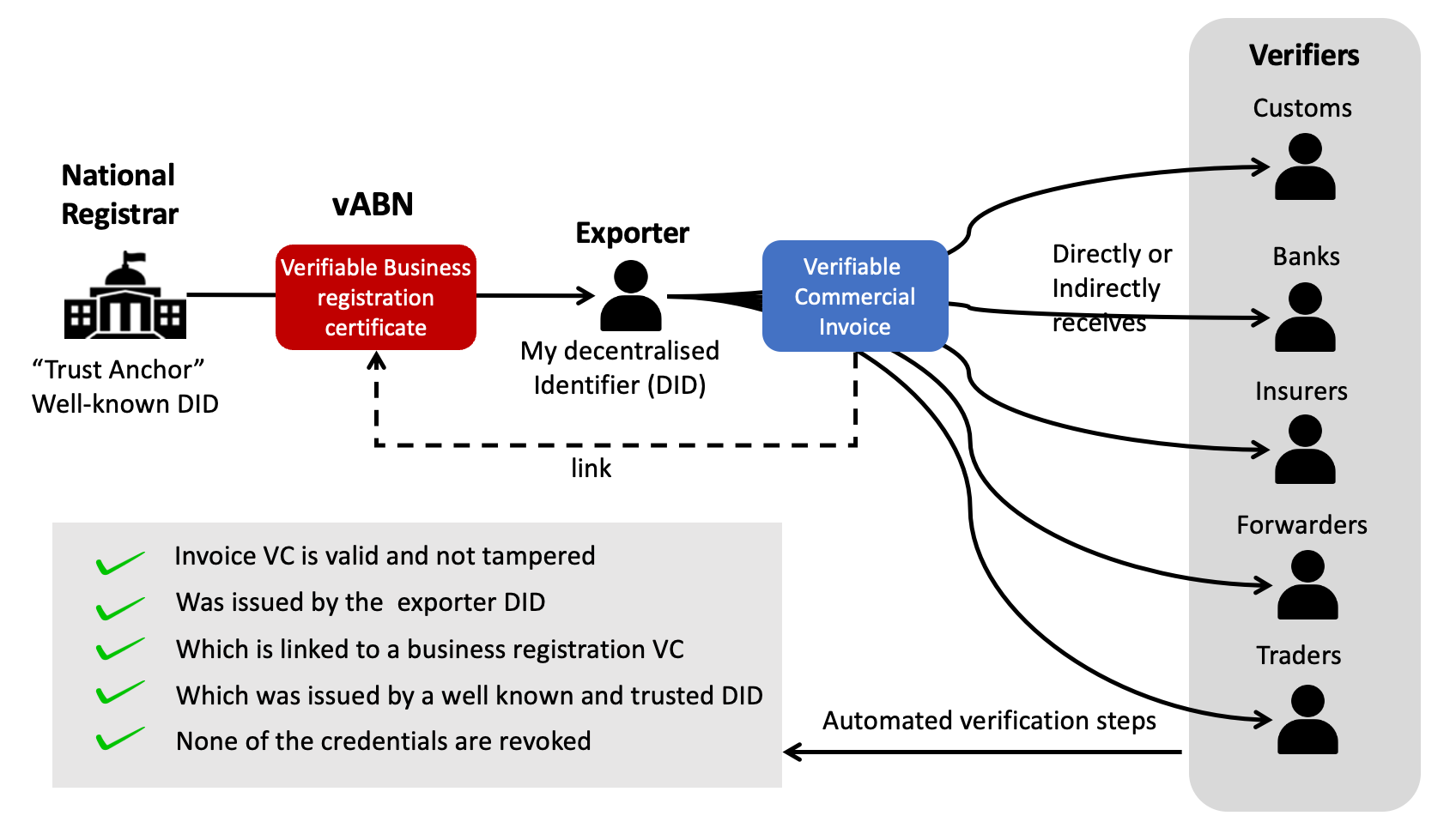
Trust anchors are institutions society already relies on — national business registers, customs authorities, IP offices — now issuing their registrations as verifiable credentials (vBN, vAEO, vTrademark, etc.). When a verifier receives a trade document, the automated verification steps are:
- The document’s cryptographic signature is valid and untampered.
- The document was issued by a specific DID.
- That DID is linked to a verifiable identity credential (e.g., a business registration).
- The identity credential was issued by a well-known, trusted authority.
- None of the credentials in the chain have been revoked.
No single global identity system is required. Trust is institutional and social — technology only makes existing trust systems digitally verifiable. Trust registries remain architecturally independent from UNVTD; the UN/CEFACT Global Registrar Information Directory (GRID) develops standards for this purpose, but organizations may use any trust framework.