Business Use Cases
The Opportunity
International trade is enormous — approximately $25 trillion in annual FoB exports, moving between 10 million businesses, shipping 10 billion tons of cargo as 2 billion consignments between 100,000 land, sea, and air ports. The costs and frictions embedded in this system are equally enormous.
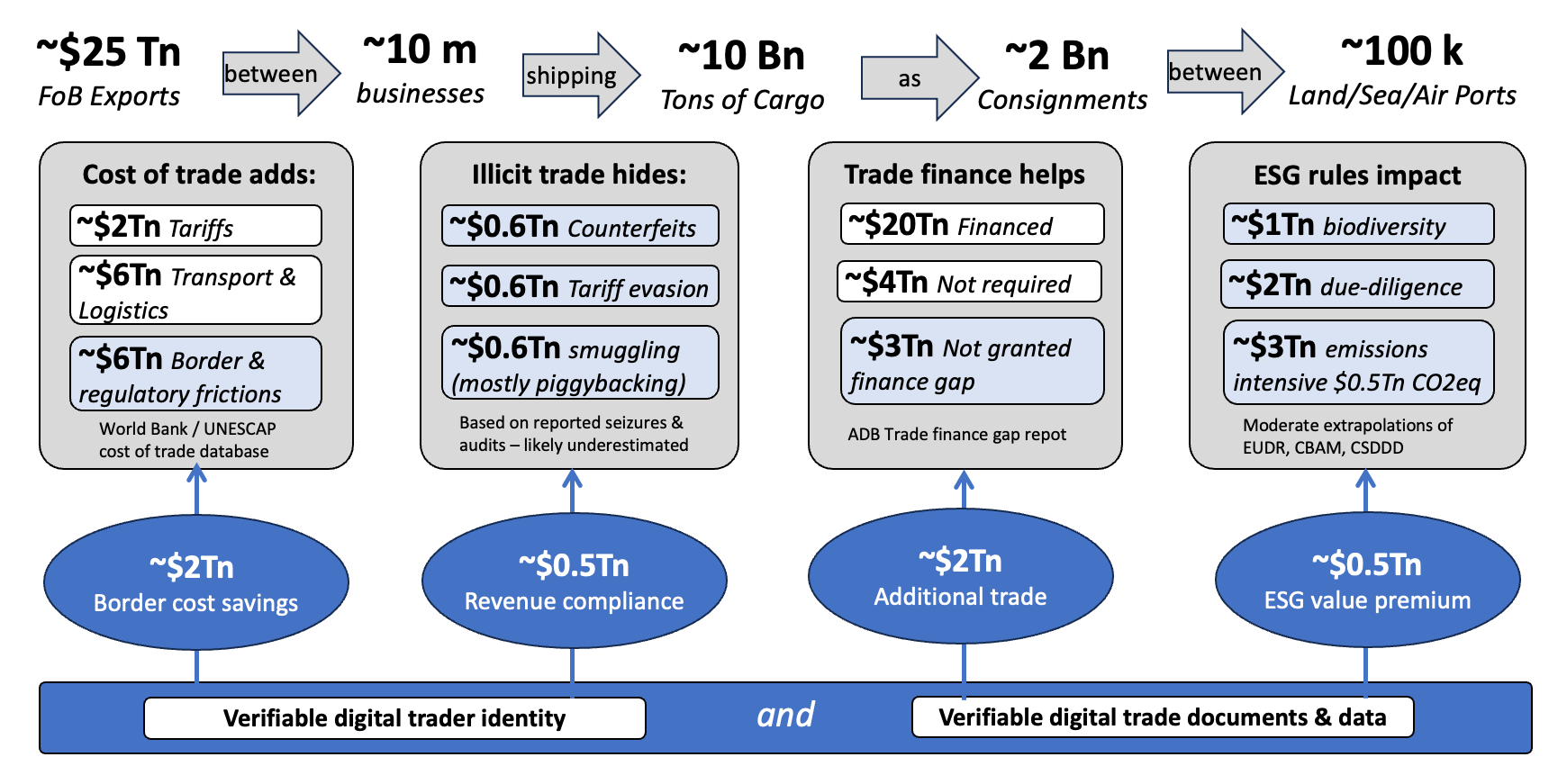
The combination of verifiable digital trader identity and verifiable digital trade documents can unlock value across four major dimensions:
- Border cost savings (~$2Tn opportunity) — The cost of trade includes ~$2Tn in tariffs, ~$6Tn in transport and logistics, and ~$6Tn in border and regulatory frictions. Verifiable documents and identity can significantly reduce processing costs and delays.
- Revenue compliance (~$0.5Tn opportunity) — Illicit trade hides ~$0.6Tn in counterfeits, ~$0.6Tn in tariff evasion, and ~$0.6Tn in smuggling. Verifiable documents make fraud far harder to conceal.
- Additional trade (~$2Tn opportunity) — Of ~$20Tn in financed trade, ~$3Tn in demand is unmet (the trade finance gap, per the ADB Trade Finance Gap Report). Verifiable documents reduce due diligence costs and can broaden finance access, particularly for SMEs.
- ESG value (~$0.5Tn opportunity) — Regulations such as EUDR, CBAM, and CSDDD impact ~$1Tn in biodiversity-linked trade, ~$2Tn in due-diligence scope, and ~$3Tn in emissions-intensive trade. Verifiable evidence supports compliance and can unlock value premiums.
A Composable Standards Framework
No single standard addresses all of these impacts alone. Three complementary UN/CEFACT standards — each delivering verifiable credentials for different aspects of trade — compose together to address 15 distinct business impact scenarios across three categories.
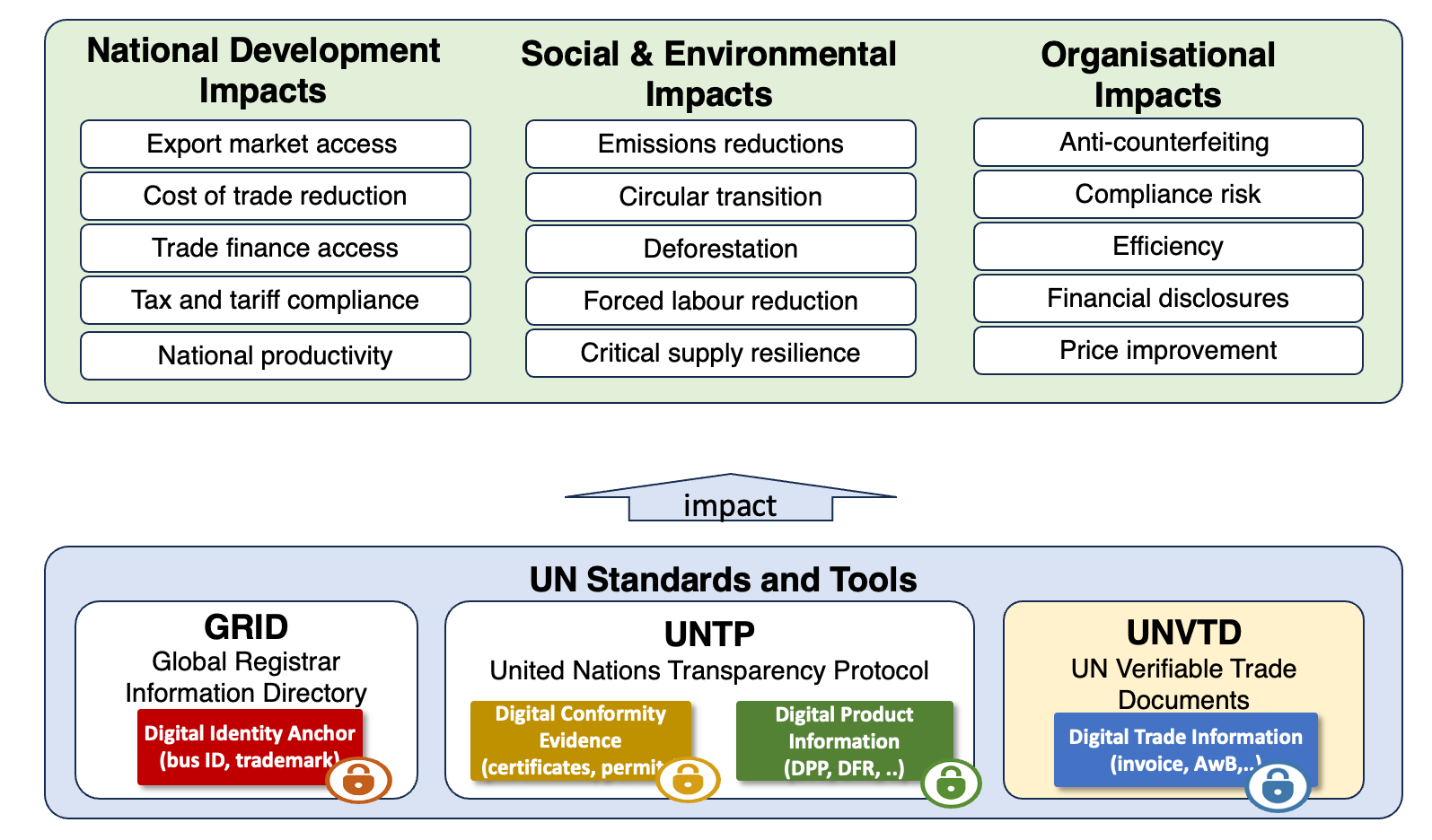
GRID — Global Registrar Information Directory provides digital identity anchors (verifiable business identities, trademarks, and similar registrations) that serve as the trust foundation.
UNTP — United Nations Transparency Protocol provides digital product information (product passports, facility records) and digital conformity evidence (certificates, permits) for sustainable and resilient supply chains.
UNVTD — UN Verifiable Trade Documents provides digital trade information (invoices, bills of lading, customs declarations, and more) for paperless and trustworthy trade.
Together, these standards enable a verifiable digital thread from trader identity through product provenance to trade documentation — each independently useful, but most powerful when combined.
Impact Scenarios
The impacts fall into three categories:
National Development Impacts — export market access, cost of trade reduction, trade finance access, tax and tariff compliance, and national productivity.
Social & Environmental Impacts — emissions reductions, circular transition, deforestation, forced labour reduction, and critical supply resilience.
Organisational Impacts — anti-counterfeiting, compliance risk, efficiency, financial disclosures, and price improvement.
The use cases in this section present quantifiable value propositions at both national and organisational level for many of these impact scenarios:
- Maritime Trade — containerized goods by sea, involving exporters, importers, carriers, freight forwarders, and port authorities. Document-intensive and involving transferable instruments alongside standard commercial documents.
- Border Compliance — customs clearance and regulatory compliance at import and export borders, where verifiable documents can streamline declarations, reduce fraud, and enable risk-based processing.
- Trade Finance — letters of credit, documentary collections, and supply chain financing, where verifiable documents reduce due diligence costs and can broaden access for SMEs.