Pilot Design Architecture
Project: UN/CEFACT GRID Pilot
Version: 5.1 (Refactored Ingestion)
Status: Operational / Ready for Scale
1. Executive Summary
The Pilot Design has been developed by considering how to create a representative model of the "logical model" for the GRID. There are key elements of the logical model design that we want to explore, such as a discovery service supported by a decentralised and loosely coupled approach that retains sovereignty and resilience.
We chose to constrain the pilot to the resources already available from the environment of the UNICC Gitlab instance and then to consider how this might work with Registrars and their potential use of gitlab.com and/or github.com repositories.
The intent is that this design is low (to zero) cost and simple enough to enable quick set up and use, but useful enough to help drive real insights into the requirements for the GRID operational design, and for the GRID participants.
At the time of writing, the operational design and implementation of the GRID is expected to be subject to an appropriate UN request and procurement process. The pilot design presented here is intended solely to explore how different approaches might work, not to dictate the chosen design.
The logical model for GRID is shown below.
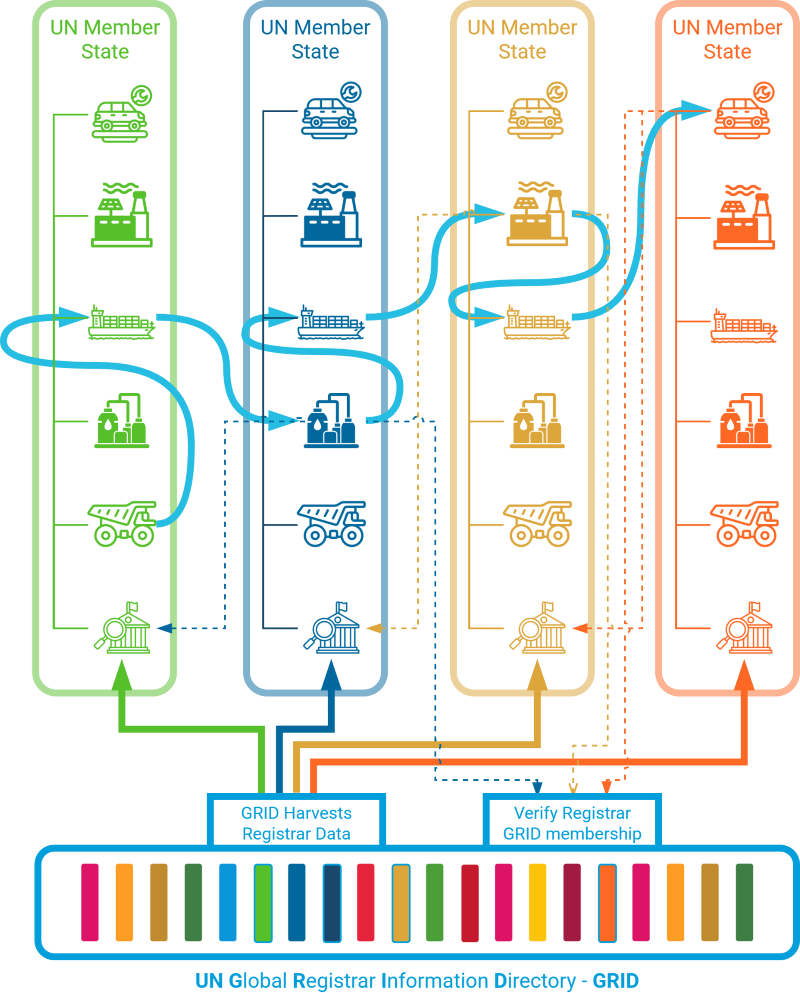
Overview of pilot design
The GRID Pilot is a decentralized system where "Sovereign Nodes" (pilot representatives of Authoritative Registrars of UN Member States) manage their own data in their own repositories. A UNICC hosted build process "harvests" the data shared by participating registrars, and checks that the data has been cryptographically signed by the participant's registered cryptographic key. The pilot makes use of the built in capability of git systems to provide version control and signing commits and verification using cryptographic keys. GPG keys are used to enable more sophisticated key management processes.
Key objectives of the pilot are to explore and demonstrate how the design enables the GRID to stay "lightweight", by only harvesting presented metadata, while the Authoritative Registrars maintain control over their data and separating the GRID aspects from the lifecycle of the DIAs they issue.
2. Key Design Decisions
2.1 The Resilient Harvest Model
The pilot uses a "harvest" approach which simulates a global directory that does not "own" data but collects participant published data and points to the participant's source. This supports the objective that even if the UNICC GRID service fails, the Sovereign Nodes retain their service capability as the primary records of truth.
Instead of a centralized database where Registrars might log in to edit their data, we use a Pull ("harvest") Model.
-
Decision: We do not host the data source; we mirror it to enable metadata discovery. Registrars remain responsible for the integrity and hosting of their data
-
Benefit: Sovereignty and Resilience. If UNICC GRID goes offline, the Sovereign Node's data remains accessible and verifiable in their own repository.
Importantly, this approach is consistent with the issuer holding linked data model proposed by the UNTP Specification.
2.2 Dual-Stack Verification (SSH & GPG)
For the pilot design, we support two verification methods to accommodate different infrastructure maturity levels.
-
Internal Bootstrap Nodes: Verified via SSH Signatures against a local
allowed_signersfile (Native Git Verify). This is so that we can rapidly make changes to our dummy/trial entries within the GTR Gitlab environment. A number of fictitious participants have been set up to test this approach. -
External Sovereign Nodes: Verified via GPG Signatures against a Keyring (Harvester Verify). These will be representatives of the UN Member State pilot participants (e.g. Spain, Canada, India, Netherlands etc.)
Pilot Cryptographic Key Choice Explanation: SSH keys primarily authenticate access to remote systems, while GPG (GNU Privacy Guard) keys offer broader functionality for data encryption and digital signatures, including more robust key management like built-in expiration and revocation, making them better for verifying data integrity (like Git commits/tags) and securing communications (emails/files). GPG signatures provide detailed identity, expiration, and usage control within a "web of trust," whereas SSH signatures are simpler, often reusing existing keys, but lack native expiration, making GPG more versatile for supply chain security.
Note that this key management approach is solely to test the logical model design. The final operational design will define its own key management approach.
Design objectives:
-
the Pilot should ensure that issuing and updating an entry's status in a register (including revocation) is a local registrar action that requires zero interaction with the central GRID Hub. Only a change in the Registrar's own "Identity Anchor" data triggers a GRID update.
-
The design should allow a separation between registrar keys used for the GRID interactions and those used for DIA issuance and other registrar operations.
2.3 Internal design consequence - "Sidecar" Verification (Chain of Custody)
Having decided to use a Git based model and a pull (harvest) mechanism, a technical detail to solve was that Git Signatures live in the .git folder, not the file itself. When moving files to the build stage (part of the site CI/CD pipeline process), the signature is lost.
-
Solution: We verify at source (during a clone operation) and generate a
.sig"sidecar" file. -
Mechanism:
companies.mdis paired withcompanies.sig. -
Result: The build script trusts the sidecar, maintaining the chain of custody across pipeline stages.
2.4 Delegated Trust (One Key, Many Registrars)
We use a simple Root of Trust model, where one DID is used per participant and a participant may have many registrars. This provides simplicity for the Pilot and mirrors an effect that we would like to see in operation, where Registers are verifiably under the control of the participating UN Member State authority.
-
Decision: The Sovereign DID (e.g.,
did:web:...:genovia) and its associated GPG Key represent the Pilot Participant UN Member State - in this case the fictitious land of Genovia. -
Mechanism: That single key signs multiple files (e.g.,
companies.md,land.md). -
Outcome: The GRID table shows multiple registrars for the same country, all verified by the same Sovereign Anchor.
2.5 Design Consequence Subfolder Ingestion Strategy
Given that we are replicating and presenting files on the website (using Docusaurus), to prevent filename collisions (e.g., both UK and France submitting companies.md), we handle namespacing at the ingestion level.
-
Method: Harvester sorts files into folders (
external/GEN/companies.md) and prefixes the filenames with the country code (if not already present) -
Benefit: The Generator script treats Internal and External files identically, removing logic duplication and "double-prefix" bugs.
3. Technical Implementation
3.1 The Harvester (.gitlab-ci.yml)
The pipeline runs on a schedule to ingest external data.
-
Inject Credentials: Uses git-credential-store to clone private sovereign repos.
-
Import Key & Trust: Imports the Sovereign's Public GPG Key and applies signature checks against the pulled content.
-
File naming and placing:
-
Reads
country_codefrom the harvested file frontmatter (e.g., "GEN"). -
Creates a directory
registrars/external/GEN/. -
Copies the verified file and its
.sigsidecar into that directory.
-
3.2 The Generator (generate-grid.js)
The script acts as the verification and publishing engine.
This approach can/will be improved on. For example:
-
Only pull data from registers with updates, and only update those files that have changed. This current release (5.1) cleans and builds everything which is inefficient and that means that if a Registrar is temporarily unavailable during the harvest and build, they will disappear from the GRID for that build.
-
The operational (and preferably the pilot) system need a better mechanism to manage the list of Registrars to pull data from.
-
Changes to the schema for the Registrar data should be published so that participants can read the schema and check ("parse") their updates to ensure that they meet the schema definition before publication.
Some further notes on functions of the pilot:
-
Hygiene: Cleans the
docs/registrarsfolder on every run to remove "ghost files" from previous runs. -
Recursive Scan: Recursively finds markdown files in both
internal/andexternal/subfolders. -
Strict Mode Verification:
-
Internal: Checks
git logfor SSH signature statusG. -
External: Checks
.sigsidecar for GPG statusG. -
Rejection: Any status other than
G(Good) is marked as "Unverified" or "Bad".
-
-
Unified Renaming:
-
Applies the Country Code prefix to all files at the final stage.
-
Input:
internal/atlantis/companies.md-> Output:ATL_companies.md -
Input:
external/GEN/companies.md-> Output:GEN_companies.md
-
3.3 The Frontend (Docusaurus)
The GTR website is built using Docusaurus. This influenced and has consequences on the pilot design, including:
-
Build Time: The formatted Markdown files are copied into the Docusaurus
docs/folder. -
Display: The
grid-directory.mdpage is built by the script and renders a sortable table with the Trust Badges displayed. -
Linkage: Clicking a registrar name opens the detailed page (e.g.,
docs/registrars/GEN_companies.md). With content created by and copied from the Country Registrar repository during the clone operation.
4. Operational Guide for Ops Team
Adding a New Pilot Participant
To onboard a new participant (e.g., Australia), the UNICC team:
-
Receive Secrets: gets the Repo URL, Deploy Token (User/Pass), and Public Key (
.asc) from the participant lead. -
Update Variables: Adds
AUS_USERandAUS_PASSto the GitLab CI/CD Variables. -
Update Pipeline: Edits
.gitlab-ci.yml:-
Add a
git credential approveblock for the new user. -
Add a
git cloneblock for the new repo. -
Add the
keys/australia.ascfile to the repo. -
Add the import logic to the script.
-
-
Commit: The next pipeline run will automatically harvest, verify, and display the Australian nodes.
This is another area for design improvement. The process of adding a new participant is currently very manual (cut and paste and several steps). Clearly a production environment would improve on this. However this is a pilot and the aim is to realise the need for these requirements so that they can be specified for the operational system.
5 Detailed Design
This architecture enables a pilot of the UN/CFACT GTR Project "Global Registrar Information Directory" (GRID). It simulates a trust ecosystem using standard Git cryptography and CI/CD automation.
The system uses a hybrid data model of dummy pilot participants and active actual participants:
-
Bootstrapped Data: Fictitious participants (Atlantis, Gondal, Ruritania) hosted internally for testing and demonstration.
-
Sovereign Data: Real pilot participants (e.g., Spain, Canada, Netherlands, UK, Australia) hosting data in their own controlled repositories, which are "harvested" by the central system.
5.1 Overview
The system is built within a Static Site Generator (Docusaurus) and uses build scripts that aggregate data from multiple sources into a single verifiable directory.
5.2 The Components
-
The GRID Hub (UNICC): The central Docusaurus project. It hosts the website, the fictitious DIDs, and the aggregation pipeline.
-
The Sovereign Nodes (repositories on GitLab.com, GitHub should also work): Private projects owned by Pilot Registrars. They publish only their specific registrar data.
-
The Identity Layer (GPG): Participants sign their data commits with GPG keys, creating a verifiable "Digital Identity Anchor" within the Git log.
Note that we are choosing to use GPG keys where possible since this will let us test revocation, rotation and other key management functions.
5.3 Bootstrapping Strategy (Fictitious Countries)
To test the system immediately, we establish three internal fictitious entities (Atlantis, Gondal and Ruritania) and one fictitious external entry (Genovia).
5.4 DID Hosting (The static Folder)
For the pilot we are using the did:web path-based standard. Docusaurus publishes files in the /static directory verbatim, allowing us to host raw JSON DID documents.
Directory Structure (UNICC Repo):
/static/pilots/
          ├── atlantis/
          │   └── did.json
          ├── gondal/
          │   └── did.json
          └── ruritania/
              └── did.json
The resolution URL for the Atlantis DID becomes:
https://un.opensource.unicc.org/unece/uncefact/gtr/pilots/atlantis/did.json
And the DID string is:
did:web:un.opensource.unicc.org:unece:uncefact:gtr:pilots:atlantis
5.5 Data Storage
The Markdown data for these countries is stored directly in the central repository to simplify management.
Location: /registrars/internal/
Files:
-
atlantis.md
-
gondal.md
-
ruritania.md
5.5 The Sovereign Node Strategy (Real Pilots and the Genovia example)
Live pilot participants need data sovereignty. This will require unique/distinct git repositories that they manage.
5.5.1 External Repository Setup
-
Host: GitLab.com (Public Cloud). (GitHub should work too)
-
Visibility: Private (initially) or Public.
-
Authorization: The project owner creates a Group Deploy Token (read-only) and provides the credentials to the UNICC Pilot Lead. This is to enable the "Harvest" operation.
5.5.2 Data Storage
The participant manages a single file in their own repo: registrar-info.md.
5.6 Data Specification (Markdown + Frontmatter)
This format bridges the gap between machine-readable data (YAML) and human-readable context (Markdown).
The JSON structure for the GRID is part of the deliverable documentation and is used actively by the pilot design. The JSON is defined in the registrar-v1.json file, here.
The schema is validated by the validate-schema.js script, here
Example markdown
---
#machine readable code
UN_member_state: GV
subdivision_code: null
registrar_full_name: "TP: Royal Ministry of Genovia Companies"
registrar_identifier_code: TP-MGC
register_name: "TP: Genovia Company House"
register_type: "Organisation"
legal_basis: https://legislation.genovia.gov/companies-act
authoritative_body: https://ministry.genovia.gov
register_id: "https://companies.genovia.gov"
registered_id_description: "9-digit numeric code in 3 blocks of 3-digits with a 2-digit prefix"
registered_id_pattern: "GV.TP-MGC.^\\d{2}\\s\\d{3}\\s\\d{3}\\s\\d{3}"  # Note: In YAML strings, escape backslashes!
id_example: "GV.TP-MGC.51 824 753 556"

# Pointing to your Docusaurus static path
did: "did:web:gitlab.com:gtr-pilots:genovia"
status: "active"
contacts: "11dot2+genovia@gmail.com"

# Using a test pilot GPG key here, because we are signing for the Registrar
signing_key_id: "2EBA5339DBEE1079D295A3DE7782530389BB46E3"
---

## Royal Ministry of Genovia

### Verification Policy

This registry is a test pilot bootstrap node managed by the GTR Project Team for Companies registered in the fictitious UN Member State of Genovia. None of the content here is official.

This fictitious registry is hosted on gitlab.com, here: https://gitlab.com/gtr-pilots/genovia
5.7 The Aggregation Logic (The Scripts)
The GRID is generated dynamically by the generate-grid.js script, here
The logic must handle two distinct data sources (local/internal and external).
5.7.1 The Directory Structure
The Central Project (gtr) organizes input data as follows:
/
├── static/                 # Hosted DID Docs
├── registrars/
│   ├── internal/           # Fictitious Markdown files (Committed here)
│   └── external/           # Real Pilot files (Cloned here by CI)
└── scripts/
    ├── generate-grid.js    # The Logic Engine
    └── validate-schema.js  # The parsing engine - reads the json schema
5.7.2 The Generator Script (scripts/generate-grid.js)
This script scans both folders, validates YAML, checks GPG signatures, and builds the table.
See the GTR GitLab repo for the current build version of this script: generate-grid.js
5.7.3 The Pipeline (.gitlab-ci.yml)
Configured to clone each instance of external Pilot participant data.
See the UNICC GTR GitLab repo for the current version of this document: [.gitlab-ci.yml]((https://opensource.unicc.org/un/unece/uncefact/gtr/-/blob/main/.gitlab-ci.yml)
This would be another area of obvious improvement. Adding a new Pilot participant requires a copy/paste/update operation of a chunk of the yml below. The operational solution would require a more elegant approach to managing participants
6. Future Improvements
The pilot design is deliberately constrained, there are a number of future improvements that may be considered:
-
Automated Membership Management: Transitioning from manual
.ymlupdates to an Automated Onboarding Portal where Registrars submit their own Public Keys and metadata. Note that this requires a logical separation of the eligibility processing of applications to join the GRID, and the onboarding of successful applications. -
Cost-Recovery Simulation: Tracking the "Compute/Storage Credits" used by each node to model the future annual membership fee (the ICAO-style fee calculation).
-
Resilience Testing: A "Chaos Engineering" test where the central Hub is intentionally taken offline to prove that DIAs held by supply chain participants remain verifiable locally.