Please note that this content is under development and is not ready for implementation. This status message will be updated as content development progresses.
Textile Sourcing Patterns
The page is part of the UNTP Textile Guidance section. It describes how the UNTP credential architecture supports common commercial sourcing structures found in textile supply chains.
Overview
Textile supply chains share three core actors – Supplier, Manufacturer, and Brand – but the commercial relationships between them differ significantly depending on who holds the sourcing contract. These differences often determine what data is visible and to whom, what must remain confidential, and which UNTP components carry the trust.
The UNTP supports both sourcing patterns with the same set of credential types. The protocol does not require different implementation for each pattern; rather, it is the access control configuration and credential linkage that varies.
| Brand-Directed Sourcing | Manufacturer-Directed Sourcing | |
|---|---|---|
| Who contracts the Supplier? | The Brand directly | The Manufacturer |
| Supplier identity visible to Brand? | Yes — discoverable before contracting | No — commercially sensitive |
| Trust mechanism | Pre-contract DFR discovery + full upstream DPP chain | Third-party Scope Certificate acts as trust bridge |
| UNTP components in use | DFR, DPP, Transaction Certificate | DFR (encrypted), Scope Certificate, Transaction Certificate, DPP |
| Access control pattern | Anonymous public / authenticated access | Encrypted upstream; confidential supplier identity |
Pattern 1 — Brand-Directed Sourcing
In Brand-Directed sourcing, the Brand contracts both the Supplier and the Manufacturer independently. The Brand selects certified raw material sources directly and arranges contract manufacture separately. This gives the Brand — and requires from it — full upstream visibility.
The Supplier's facility record and certifications are discoverable before any contract is signed, enabling pre-contract due diligence without relying on the Manufacturer as an intermediary.
How it works
The diagram below shows the main actors and the flow of certificates and Digital Product Passports (DPPs). The Brand contracts both the Supplier and the Manufacturer; material and credentials flow from Supplier → Manufacturer → Brand.

Figure: Brand-directed sourcing — who contracts whom, and which credentials flow where.
The sequence diagram below shows the same flow in more detail (discovery, contracting, and credential handoffs).
UNTP Credentials Used
| Credential | Issued by | Consumed by | Purpose |
|---|---|---|---|
| Digital Facility Record (DFR) | Supplier | Brand | Pre-contract discovery of facility location, certifications, and labour conditions |
| Scope Certificate | Third-party certifier | Brand / Manufacturer | Machine-verifiable confirmation that the Supplier's facility is certified under a recognised scheme |
| Digital Product Passport — fabric/yarn | Supplier | Manufacturer | Links the material batch to the certified Supplier facility and its ESG claims |
| Transaction Certificate — material | Certifier | Manufacturer | Confirms that the specific shipment used certified inputs |
| Digital Product Passport — garment | Manufacturer | Brand | Links the finished product to the upstream input DPP and the manufacturing facility |
| Transaction Certificate — garment | Certifier | Brand | Confirms that certified materials were used in the finished garment shipment |
Access Control
Because the Brand contracts directly with the Supplier, there is no commercial reason to conceal the Supplier's identity. The Supplier's DFR is published with anonymous public access via the identity resolver. The full upstream credential chain — from Supplier DFR through to the garment DPP — is linkable and verifiable end-to-end.
See Decentralised Access Control for the underlying access patterns.
Pattern 2 — Manufacturer-Directed Sourcing
In Manufacturer-Directed sourcing, the Manufacturer independently sources certified raw material and on-sells finished goods to the Brand. The Supplier is the Manufacturer's own commercial relationship. The Brand is not, and should not be, entitled to know the Supplier's identity — this is proprietary information that underpins the Manufacturer's competitive position.
The challenge this creates is real: the Brand still needs verifiable assurance that sustainable inputs were used, without the Manufacturer being compelled to disclose who supplied them.
The UNTP resolves this through third-party certification as a trust bridge. An independent certifier audits both the Supplier and the Manufacturer, sees the full chain, and issues machine-verifiable credentials that allow the Brand to trust the outcome without seeing the underlying relationship.
How it works
The diagram below shows the four main actors and the trust model. The Certifier audits both the Supplier and the Manufacturer and issues Scope Certificates; the Brand sees only what crosses the boundary (garment DPP and Transaction Certificate) and trusts the Certifier for upstream assurance. The Supplier's identity, DFR, and input DPP stay encrypted upstream.
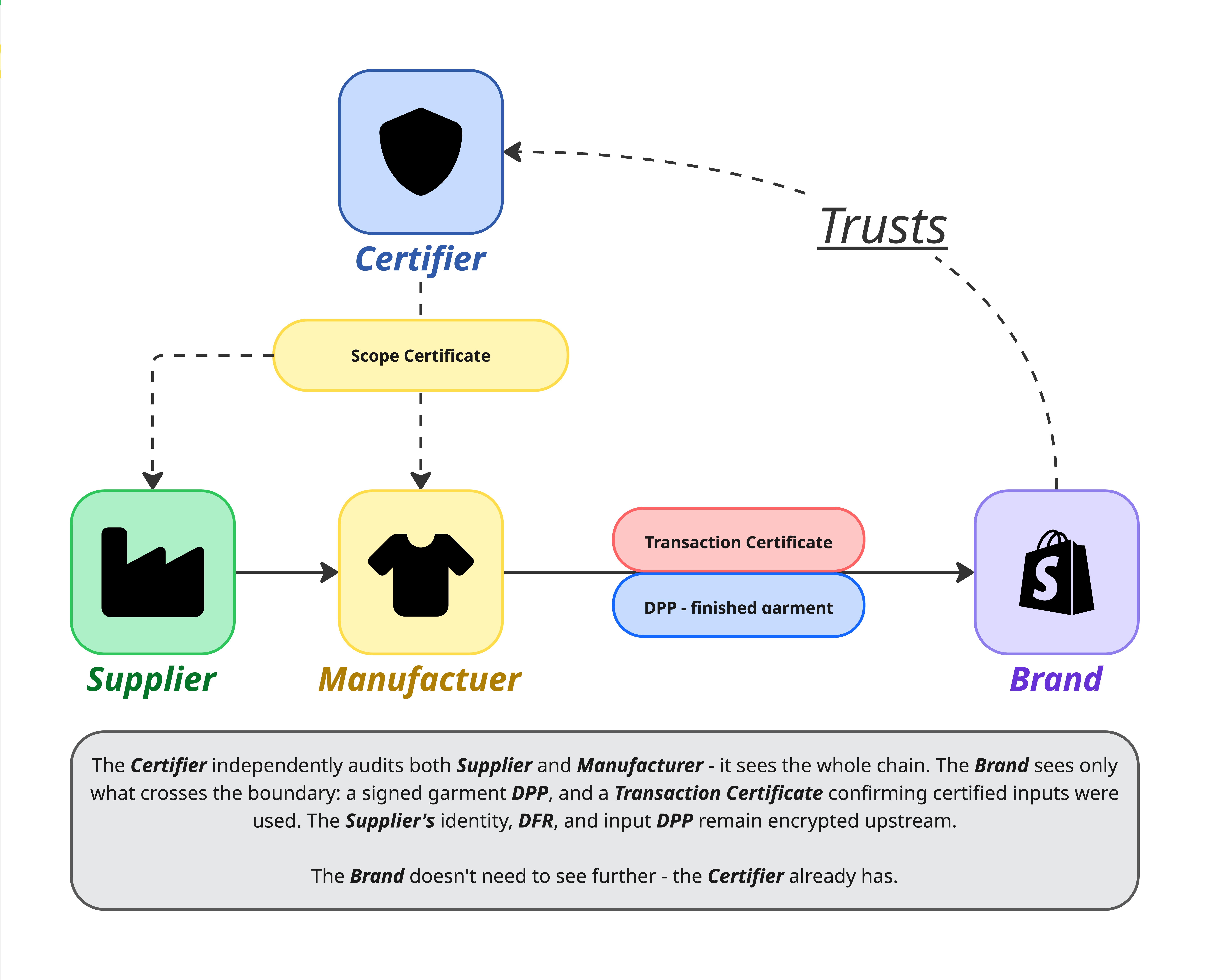
Figure: Manufacturer-directed sourcing — the Certifier as trust bridge; Supplier identity and upstream credentials remain confidential.
The sequence diagram below adds the audit and credential-issuance steps.
UNTP Credentials Used
| Credential | Issued by | Consumed by | Purpose |
|---|---|---|---|
| Digital Facility Record (DFR) | Supplier | Manufacturer / Certifier | Facility data, certifications, and labour conditions — encrypted, not disclosed to Brand |
| Scope Certificate | Third-party certifier | Manufacturer, Brand | Acts as the trust bridge: independently confirms certified inputs were used without revealing the Supplier |
| Digital Product Passport — garment | Manufacturer | Brand | Links the finished product to the certified manufacturing facility; upstream DPP links are encrypted |
| Transaction Certificate — garment | Certifier | Brand | Machine-verifiable confirmation that certified inputs were used in the specific shipment |
| Digital Identity Anchor (DIA) | Accreditation body | Brand | Allows the Brand to verify the Certifier's own accreditation, closing the trust loop |
Access Control
The Supplier's DFR and the input-level DPP are encrypted. The Manufacturer does not expose — and cannot be forced to expose — the identity of their Supplier to the Brand. The certifier, however, has seen and audited the full chain.
The Brand receives:
- A signed garment DPP from the Manufacturer
- A Transaction Certificate from the accredited Certifier confirming certified inputs were used
- A verifiable link to the Certifier's own Digital Identity Anchor confirming their accreditation
This is sufficient for regulatory due diligence. The Brand doesn't need to see further — the Certifier already has.
See Decentralised Access Control — N-tier supplier visibility for the underlying confidential supply chain pattern.
UNTP Components at a Glance
Each UNTP component plays a distinct role and they work together regardless of sourcing structure.
| Component | Role in Textile Sourcing |
|---|---|
| Digital Facility Record (DFR) | Facilities publish verifiable records — location, certifications, labour — discoverable by anyone with the identifier and correct access. Brands can vet suppliers before contracting, not after audits. |
| Digital Product Passport (DPP) | Every product batch carries a signed, tamper-evident credential linking its sustainability claims to the facility that made it and the inputs that went into it. Traceability upstream, subject to access control. |
| Conformity Credential — Scope & Transaction Certs | Third-party certifiers issue machine-verifiable credentials. Scope Certs cover facilities; Transaction Certs cover shipments. These add independent trust and act as a trust bridge in confidential supply chains. |
| Decentralised Access Control | No central platform. Each actor controls their own data — choosing what is public, what requires authentication, and what stays encrypted. |
| Digital Identity Anchor (DIA) | Links a party's decentralised identifier to their registered or accredited status, allowing any downstream actor to verify the authority of a Certifier without contacting a central registry. |
Design Principles
Both patterns are supported by the same protocol because the UNTP is grounded in two complementary principles:
Trustworthy, verifiable data — Manual verification is costly, time-consuming, and prone to errors. UNTP enables automated verification at scale: not just digitisation of paper records, but cryptographic assurance of data integrity and provenance. The shift is from occasional manual audits to ongoing automated due diligence at very low cost.
Maximise efficiency through interoperability — Buyers should not dictate different platforms to their suppliers. The UNTP allows a facility or manufacturer to publish once from their existing systems (e.g., ERP) and have all buyers access the same verifiable data — no duplicate data entry, no platform lock-in.
The sourcing pattern determines who can see what. The access control layer — not a separate implementation — is what adapts the protocol to each commercial context. The credential types remain identical across both patterns.